Banks do not typically struggle because there is no demand for trade finance.
The bigger challenge can be deciding how much of that demand they can support, where assets sit on the balance sheet and how efficiently those assets can be distributed.
For decades, much of banking has operated around an originate-and-hold model.
A bank originates a transaction, provides the funding and retains the exposure.
But as trade finance grows more connected, digital and global, a different model is becoming increasingly important: Originate. Distribute. Recycle. Grow.
This is where digital asset distribution has the potential to change the economics of trade finance.
Connecting origination with distribution
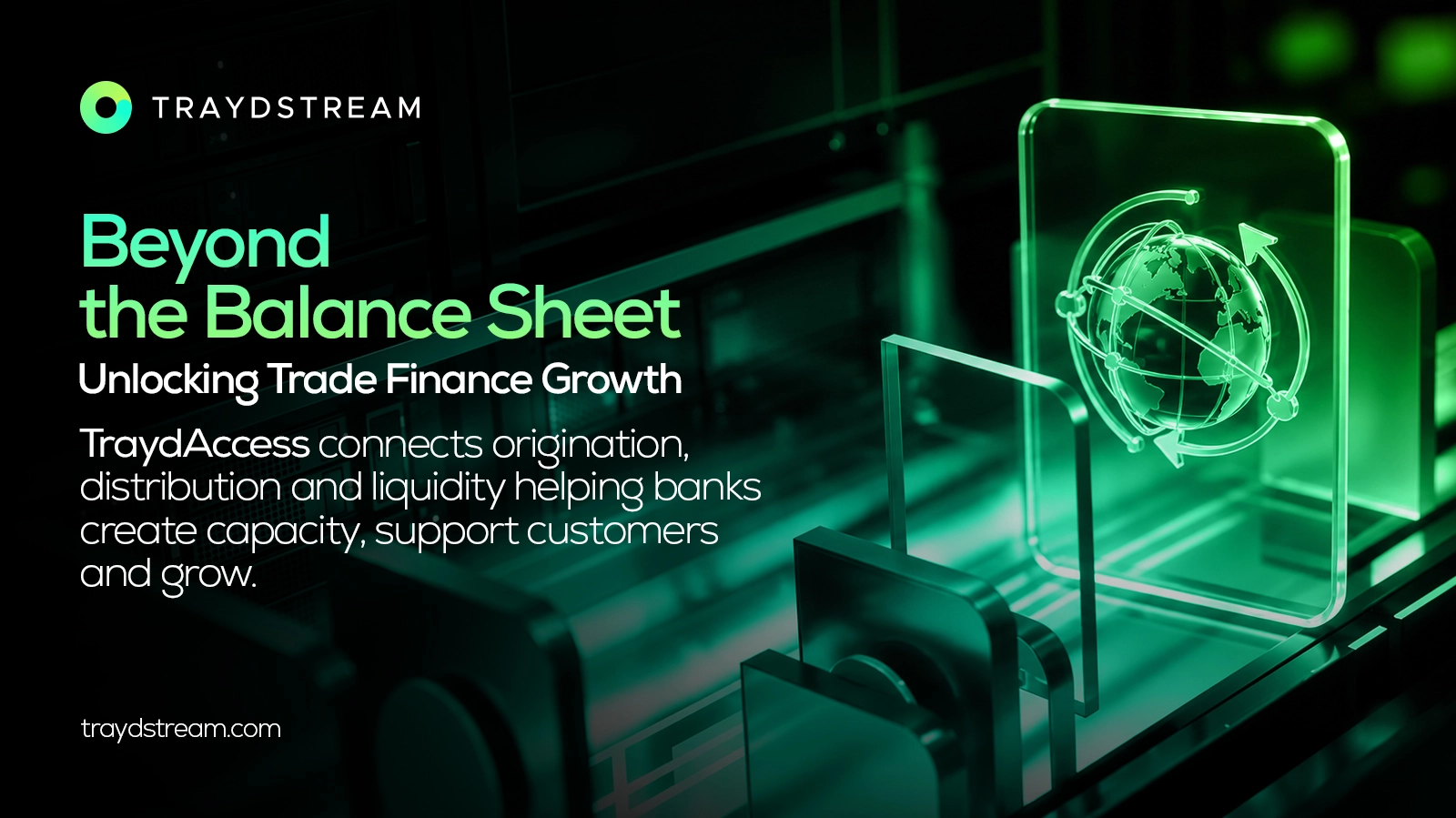
TraydAccess is Traydstream’s digital origination and distribution solution, connecting banks, corporates and funders and providing infrastructure through which institutions can originate, sell or participate in trade finance assets.
The solution is designed around simplified multi-party access, standardised legal infrastructure and secure settlement processes, while allowing institutions to maintain control over their counterparties and participation.
For banks, this extends digital transformation beyond operational efficiency.
It reaches the balance sheet.
Business Impact 1: Create capacity for more business
A successful trade franchise can eventually face a simple constraint.
The bank has customers and origination capability, but finite balance-sheet capacity.
Asset distribution creates another lever.
Rather than every originated asset remaining on the balance sheet for its full duration, eligible assets can potentially be distributed to other participants.
That can allow banks to recycle capacity and continue originating new business.
A balance-sheet constraint does not necessarily need to become a customer constraint.
Business Impact 2: Protect and deepen corporate relationships
Corporate customers do not particularly care which internal banking constraint prevents their transaction from being financed.
They simply want the financing.
If their primary bank cannot provide it, they may look elsewhere.
A broader distribution model can enable an originating bank to remain central to that customer relationship while bringing additional sources of liquidity into the transaction.
That has significant strategic value.
Instead of telling a client: “We cannot support this transaction.” the conversation can increasingly become: “Let us find the right capacity to support it.”
That helps banks remain relevant across more of their customers' trade requirements.
Business Impact 3: Expand the investor network
Trade finance assets can offer attractive characteristics to a range of institutional participants, but connecting asset originators with appropriate buyers has historically involved significant operational, legal and relationship complexity.
Digital infrastructure can simplify that process.
By creating a more connected environment for originators and participants, banks can potentially access a broader funding ecosystem while retaining control over which institutions they transact with.
Over time, this can create stronger network effects.
More originators create more assets.
More participants create greater potential liquidity.
Greater liquidity can create more opportunities to originate.
Business Impact 4: Improve the economics of origination
Distribution also changes how banks can think about the profitability of their trade franchise.
The commercial opportunity no longer has to be determined solely by the assets a bank wants to retain.
Banks can originate transactions based on customer demand while considering whether some exposure should ultimately be retained, syndicated or distributed.
That can create a more dynamic approach to portfolio management and potentially enable institutions to pursue additional business without requiring equivalent growth in retained exposure.
Business Impact 5: Move from bilateral relationships to an ecosystem
Perhaps the biggest long-term impact is strategic.
Trade finance has traditionally been highly bilateral.
One corporate. One bank.
One transaction. One balance sheet.
Digital distribution creates the opportunity for a more interconnected model involving corporates, originating banks, participant banks and alternative funding sources.
TraydAccess forms part of Traydstream's broader vision of connecting trade processing, compliance and financing within a common digital environment.
This is important because the next phase of trade digitisation is unlikely to be defined by automation alone.
It will be defined by connectivity.
From operational transformation to financial transformation
TraydCheck demonstrates what happens when banks automate the processing of trade.
TraydGuard demonstrates what happens when intelligence is applied to risk.
TraydAccess takes the transformation one stage further — into liquidity, distribution and balance-sheet optimisation.
Together, the business impact becomes much bigger than digitisation.
Banks can potentially:
- Process more efficiently.
- Understand risk more intelligently.
- Unlock additional funding capacity.
- Support more customer business.
- And connect more effectively across the global trade ecosystem.
That is where the future of trade finance becomes particularly powerful.
Technology stops being simply a way to improve the process.
It becomes a way to change the business model.
TraydAccess: connecting origination, distribution and liquidity to help banks unlock the next phase of trade finance growth.